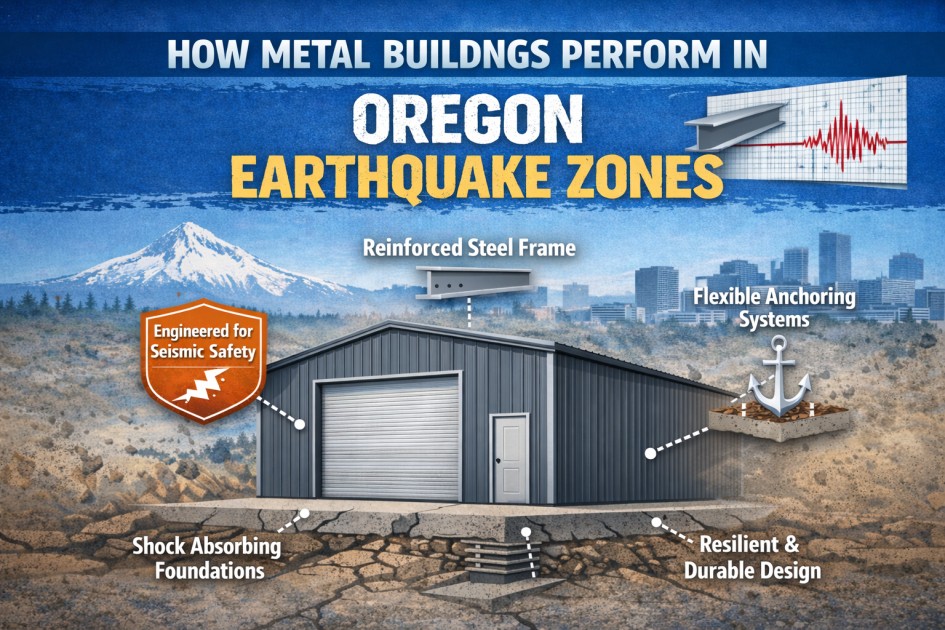
Metal buildings can perform well in Oregon’s earthquake zones due to steel’s ductility (ability to bend without breaking) and their relatively lighter weight, which reduces seismic forces. However, actual performance depends heavily on your site’s Seismic Design Category (SDC), soil class, and the engineering of the lateral force-resisting system- including bracing, diaphragm action, and robust anchorage to the foundation. Proper design per the Oregon Structural Specialty Code (OSSC) is non-negotiable. Always follow the OSSC / IBC and the guidance of your engineer-of-record.
Understanding Oregon’s Earthquake Risk
Oregon’s seismic risk is dominated by two major sources.
- The Cascadia Subduction Zone off the coast poses the threat of a very high-magnitude (M9.0+) megathrust earthquake. For coastal areas, the key concern isn’t just the intensity of shaking but its prolonged duration- potentially several minutes of strong ground motion, which tests a building’s endurance.
- Second, crustal faults (like those in the Portland Hills or near Klamath Falls) and deep intraplate quakes contribute regional hazard. It’s crucial to understand that earthquakes aren’t just one hazard. The primary threat is shaking, but that shaking can trigger:
- Liquefaction: Where saturated, sandy soils lose strength and behave like liquid.
- Landslides: On steep slopes and weak soils.
These site hazards are often the greater risk and are a major focus of the Oregon Department of Geology and Mineral Industries (DOGAMI) and local permit reviews.
What “Earthquake Zone” Really Means in Oregon (It’s Not Just a Map)
| Factor | What It Is | Why It Matters in Oregon |
| 1. Spectral Response Acceleration (Ss, S1) | The mapped “ground shaking” hazard from USGS. | Varies greatly; higher on coast, near faults, and in parts of Portland metro. |
| 2. Site Soil Class (A-F) | The type of soil/rock under your building (determined by geotech report). | Soft soils (Class E, like soft clays) amplify shaking 2-3x vs. bedrock (Class A). |
| 3. Building Risk Category (I-IV) | The building’s occupancy/importance. | A simple storage shed (Risk Cat I) has lower requirements than an emergency facility (Risk Cat IV). |
Forget old “seismic zone” maps. Modern Oregon building codes use a Seismic Design Category (SDC), from A (lowest hazard) to F (highest), which dictates design force levels. Your SDC is determined by three factors:
The takeaway: You can’t know your requirements by city alone. A metal building in Oregon on soft soil in Portland’s West Hills (SDC D or E) has vastly different needs than the same building on firm soil in Central Oregon (SDC B or C).
Why Steel Buildings Can Perform Well in Earthquakes?
When designed for Oregon’s specific conditions, metal building systems offer inherent advantages:
- Lower Mass: Steel structures are typically lighter than comparable concrete or masonry buildings. Seismic force is proportional to mass, so lower mass means lower inertial demand from the start.
- Ductility: High-quality steel has the ability to yield, deform, and absorb significant energy without sudden, catastrophic failure- a key trait for seismic performance.
- Clear Load Path: Well-engineered metal buildings are designed with a continuous, well-defined path for seismic forces to travel from the roof, down the walls, through the connections, and into the foundation.
- Certified Engineered Systems: Specialty-braced frames or moment-resisting frames are designed, and tested to perform predictably under cyclic loading.
The Make-or-Break Checklist
Theoretical advantages mean nothing without proper execution. Performance hinges on these critical, actionable details:
The Lateral System: Your Building’s “Seismic Skeleton”
This is the engineered system that resists horizontal shaking.
- Braced Frames: Ensure they are symmetrically located and designed for your SDC. Ordinary Concentrically Braced Frames (OCBF) may suffice for lower SDCs, but Special Concentrically Braced Frames (SCBF) are required for higher hazard zones for greater ductility.
- Moment Frames & Shear Walls: Other options an engineer may specify.
The Diaphragm: Transferring the Load
The roof and walls must act as stiff diaphragms to distribute seismic forces to the lateral system.
- Panel Attachment: The roof and wall panels must be fastened to the structure with the correct fastener type, spacing, and edge details per the engineered drawings.
- Openings & Irregularities: Large door/window openings or irregular building shapes can weaken the diaphragm and create stress concentrations. These require special engineering.
The Connections: Where Failure Usually Happens
The devil is in the details. Every connection is a potential weak link.
- Frame-to-Foundation Anchorage: This is paramount. Anchor bolts (embeds) must be the correct size, grade, length, and spacing, set in properly designed concrete footings. “Weak-story” conditions- like large door openings without adequate anchorage compensation- are a major red flag.
- Secondary Member Connections: Purlins, girts, and bracing must all be connected with the specified bolts, screws, or welds.
Nonstructural Hazards & Site Risks
Your building can survive but still cause loss.
- Component Anchorage: Water heaters, storage racks, and mechanical units inside must be strapped/braced.
- Site Hazards: As noted, liquefaction or landslide risk may require deep foundations (piles) or even site avoidance- issues a geotechnical report will identify.
Oregon Code & Permitting Notes
The Oregon Structural Specialty Code (OSSC), based on the IBC with state amendments, is the law. For metal buildings, this incorporates standards from AISC (steel) and MBMA (Metal Building Manufacturers Association).
Typical Permit Documents You’ll Need:
- Site Plan: Showing location, setbacks, and any hazards.
- Geotechnical Report: Often required to determine Site Soil Class and foundation recommendations. Critical for coastal and valley sites.
- Engineered Construction Drawings (Sealed): Must include:
- Site-specific Seismic Design Criteria (SDC, etc.)
- Foundation/Anchor Bolt Plans
- Framing Plans & Elevations
- Lateral Force-Resisting System Details
- Connection Details (diaphragm, brace, column base)
- Manufacturer’s Specs/Calculations (if a pre-engineered metal building)
- Product Specs/Truss Drawings: From your building supplier.
Buying a Metal Building in Oregon? Your Quote & Design Checklist
Copy and paste these questions when requesting quotes or reviewing plans:
For Your Site:
- What is my Seismic Design Category (SDC) and Site Soil Class?
- Does my site have a liquefaction or landslide hazard (check DOGAMI hazard viewer)?
- What Risk Category does my building use (I, II, III, or IV)?
For Your Supplier/Engineer:
- Is the building designed for Oregon’s OSSC and my specific SDC/Site Class?
- What type of lateral force-resisting system is used (e.g., SCBF, OCBF)?
- Can you provide detailed connection drawings for anchor bolts, diaphragm attachment, and bracing?
- Are the foundation design and anchor bolt schedule included and site-specific?
- How are large openings or irregularities addressed in the diaphragm design?
- Do the plans include nonstructural bracing requirements for interior components?
For Permitting:
- Do I have a complete, sealed engineer’s stamp on all structural drawings?
- Do I have the required geotechnical report?
- Are the submitted plans stamped by an Oregon-licensed engineer?
Conclusion
Metal buildings are a viable, often excellent, choice for Oregon’s seismic landscape- provided they are respected as engineered structural systems, not simple commodities. Success lies in understanding your site’s specific hazards, adhering rigorously to the OSSC, and ensuring every connection in the load path is designed and constructed with care.
If you’re planning a project in Oregon, from a homeowner’s workshop to a commercial facility, start with the right information and the right partners. Pacific Metal Buildings works with a network of Oregon-licensed engineers to provide building solutions tailored to the unique demands of the Pacific Northwest, ensuring your investment is safe, permitted, and built to last.
Ready to discuss your Oregon metal building project with seismic safety in mind?
Get a Quote for Your Oregon Project– Our team can connect you with the engineering resources needed for a successful, code-compliant build. For more detail call us today at +1 (530) 438-2777 for more information, and let’s design your custom structure together.
FAQs
Only if they are fully engineered and permitted for your exact site conditions. Many “kit” buildings are designed for minimal snow/wind loads and low seismic zones. Using them in Oregon’s higher SDCs without a professional engineer’s review is risky and unlikely to be permitted.
The slab itself is not the primary foundation for seismic resistance. The building’s steel columns must be anchored to continuous concrete footings or piers that are designed to resist overturning and sliding forces. The slab is often a separate element.
Absolutely. The design will simply require more robust engineering- like Special Concentrically Braced Frames (SCBF), closer attention to diaphragm design, and potentially larger/fewer openings. The cost premium for the engineering and materials is worth it for safety.
It varies widely with SDC and size. For a simple building in SDC B-C, it may be a minor factor. For a large, complex building in SDC D-F, the seismic design can significantly influence the lateral system and foundation cost. An accurate quote must be based on engineered plans.